
Intégration messagerie (IM Integration)
L’intégration IM connecte les agents à WeCom, Feishu, DingTalk, Slack, Telegram, etc. Les utilisateurs interrogent le bot sur la plateforme ; WeKnora exécute recherche et réponse selon l’agent lié.
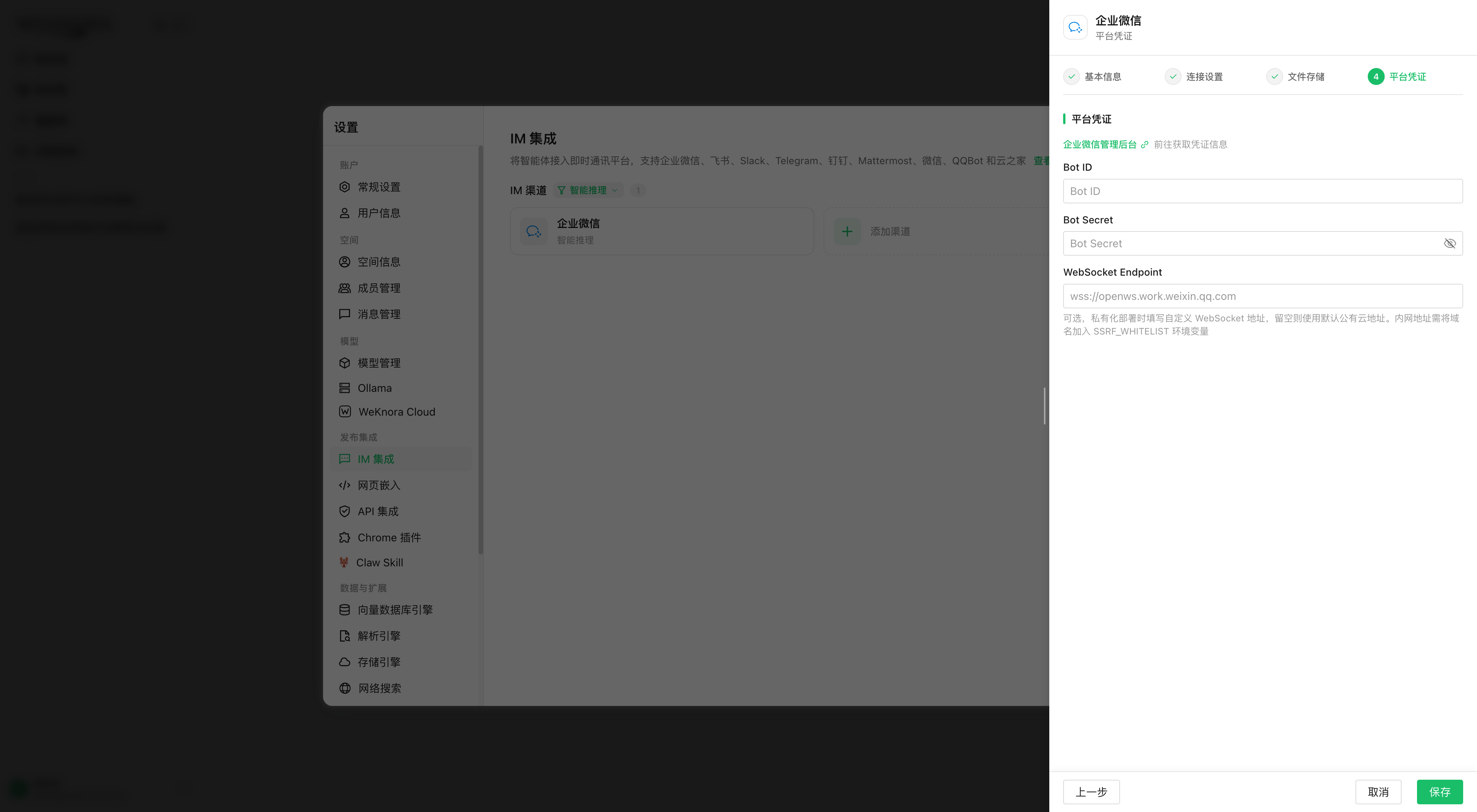
Dans « Paramètres → Intégration IM », créez un canal, choisissez la plateforme, renseignez les identifiants, liez un agent et activez. Mode webhook : URL de callback dans la console plateforme ; longue connexion : pas de callback public pour la réception. « Langue de réponse » par canal fixe la langue de l’agent ; vide = langue par défaut du déploiement.
Les plateformes supportées peuvent importer des fichiers reçus en base et exposent des commandes comme /help. Comportement selon plateforme et config canal.
Plateformes et capacités
validIMPlatforms dans internal/handler/im.go : 10 plateformes. Capacités (assertions compile-time des factory.go et adapters) :
| Plateforme | Mode (défaut en gras) | StreamSender | FileDownloader | ThreadID | Identifiants (JSON credentials) |
|---|---|---|---|---|---|
WeCom wecom | websocket (bot intelligent) / webhook (app callback) | websocket seulement | les deux | Non | websocket : bot_id, bot_secret, ws_endpoint, bot_name ; webhook : corp_id, agent_secret, token, encoding_aes_key, corp_agent_id, api_base_url |
Feishu feishu | websocket / webhook | Oui (cartes stream) | Oui | Oui (root_id) | app_id, app_secret, verification_token, encrypt_key |
Lark lark | Comme Feishu (RegionLark → open.larksuite.com) | Oui | Oui | Oui | Comme Feishu |
Slack slack | websocket (Socket Mode) / webhook (Events API) | Oui | Oui | Oui (thread_ts) | websocket : app_token + bot_token ; webhook : bot_token + signing_secret |
Telegram telegram | websocket (long poll getUpdates) / webhook | Oui (édition message) | Oui | Oui (message_thread_id Forum) | bot_token ; webhook + secret_token |
DingTalk dingtalk | websocket (Stream v0.8.2+ ; migration 000096 webhook→websocket, activer Stream dans la console) | Oui (cartes IA) | Oui | Non | client_id, client_secret, card_template_id |
Mattermost mattermost | webhook (Outgoing Webhook + REST) | Oui | Oui | Oui (root_id) | site_url, bot_token, outgoing_token (requis), bot_user_id, post_to_main |
WeChat wechat (iLink) | longpoll (forcé ; création impose mode=longpoll, output_mode=full) | Non (réponse entière) | Oui | Non | bot_token, ilink_bot_id |
QQ Bot qqbot | websocket uniquement | Non | Non | Non | app_id, client_secret, api_base_url, gateway_url |
Yunzhijia yunzhijia | webhook / websocket (WS dérivé de send_msg_url) | Non | Oui | Oui (msgId / replyRootMsgId) | send_msg_url (requis), secret, app_id, app_secret, allowed_webhook_host_suffix, timeout_seconds |
Commandes intégrées
Framework command.go / command_registry.go : commandes déclarent l’intention (CommandResult.Action), effets exécutés par le Service ; LooksLikeCommand distingue tentative commande (/help) vs chemin API (/api/v2/users) — non enregistrée → « commande inconnue », sinon Q/R.
Commandes enregistrées dans NewService :
| Commande | Fichier | Fonction | Effet de bord |
|---|---|---|---|
/help [nom] | cmd_help.go | Liste ou aide détaillée | Aucun |
/info | cmd_info.go | Agent lié : mode Agent/RAG, bases (KBSelectionMode), Skills, MCP, web, mode sortie | Aucun |
/search <mots-clés> | cmd_search.go | Recherche hybride directe sur les KB de l’agent (sans résumé IA) ; max 5 résultats, 200 runes, score % ; même portée que resolveKnowledgeBasesFromAgent | Aucun |
/stop | cmd_stop.go | Interrompt la réponse en cours (ReAct long) | ActionStop : file ou annulation locale ; événement stop StreamManager (comme Web StopSession, multi-instance via im:inflight:) ; Redis im:stop: pour requêtes en file |
/clear | cmd_clear.go | Efface la mémoire de dialogue | ActionClear : soft-delete ChannelSession, nouvelle session WeKnora au message suivant |
Groupes et messages privés
ChatType:direct(ChatIDvide) ougroup.- Feishu/Lark : en groupe, @bot souvent requis (texte
@_user_Nretiré) ; reply-in-thread, repli message normal si topic indisponible (230071, etc.) ; - Slack :
AppMentionEvent+MessageEventchannel/group (filtre bots, subtype nonfile_share) ; réponse en thread (thread_ts) ; - Telegram : group/supergroup, retrait
@botname,reply_to_message_id; - Mattermost : mot déclencheur Outgoing Webhook = premier mot ;
post_to_mainpour canal principal vs thread ; - Sessions : mode
user= session distincte par chat privé / groupe ; modethread= session partagée dans le fil.
Messages fichier
Fichiers et images = pièces jointes Q/R : contenu document au modèle, images si le modèle le supporte. Réponse normale même sans KB fichier configurée sur le canal.
knowledge_base_id = sauvegarde additionnelle en base (KB du même espace, whitelist clé API restreinte), sinon 400 à la création/màj. Tâche en arrière-plan, sans message « indexé ». Texte parsé : max 500 lignes et 32 Kio, message de troncature générique. Illisible, téléchargement impossible ou fichier de plus de 32 Mio : inviter à décrire ou renvoyer.
Images externes dans les réponses (rewrite resource://)
Citations d’images KB : resource://, local://, minio:// — clients IM ne peuvent pas les charger. rewriteStorageURLs (service.go) → URL http(s) avant envoi :
- Chaîne commune à tous les canaux IM ;
resource://selon espace et instance de stockage de la ressource ; images KB partagées = instance de l’espace propriétaire ; instance absente/inactive → WARN, pas de repli global ; - Cross-espace : vérif binding KB, partage et portée agent avant signature ; citation seule n’accorde pas l’accès ; révocation partage = plus de nouveaux liens ;
- Pièces jointes chat et fichiers générés enregistrent l’instance globale utilisée ; rétro-binding historique si chemin unique ;
- Si le résultat n’est pas http(s) : conserver la référence + WARN ;
- INFO : référence originale ; URL signées en DEBUG seulement.
Affichage images :
- Stockage public : endpoint public objet /
MINIO_ENDPOINTpublic → URL présignée ; APP_EXTERNAL_URL:<APP_EXTERNAL_URL>/r/<token>, nginxlocation ^~ /r/; image frontend officielle inclut ; proxy custom obligatoire.
MinIO interne (minio:9000) ou local → option 2. Canal IM actif sans APP_EXTERNAL_URL : alerte au démarrage (imImageConfigWarning).
Dépannage : Accès externe images et fichiers.
Notification OAuth MCP (identité)
Pas de frontend interactif pour OAuth MCP en IM :
withIMIdentity→MCPOAuthNonInteractive: pas de blocage, événement uniqueEventMCPOAuthRequired;handleMessageStreamcollecte (dédoublonnage ServiceID), fin de réponse :buildIMMCPAuthNoticeen append ; avecAPP_EXTERNAL_URL+ OAuthManager, liens par service (callback<APP_EXTERNAL_URL>/api/v1/mcp-oauth/callback, principalPrincipalIMUser= tenant+canal+plateforme+user IM) ; sinon admin WeKnora ;- Après OAuth, renvoyer le message pour utiliser le MCP.
Config et exploitation
Modèle canal (internal/im/types.go)
IMChannel (im_channels) lie un bot plateforme à un Agent :
| Champ | Description |
|---|---|
AgentID | Agent custom : modèle, KB, Skills, MCP, web |
Platform / Mode | Défauts : mattermost/yunzhijia → webhook, wechat → longpoll (+ output_mode=full forcé), reste → websocket |
OutputMode | stream (défaut) ou full |
Locale | zh-CN / en-US / ja-JP / ko-KR / ru-RU, autre → 400. Vide = WEKNORA_LANGUAGE (défaut zh-CN). Accept-Language plateforme ≠ langue utilisateur |
KnowledgeBaseID | KB fichier optionnelle ; fichiers/images toujours téléchargés pour Q/R ; si set → indexation async |
SessionMode | user (défaut : plateforme+user+groupe) ou thread (plateforme+fil+groupe) |
BotIdentity | Identité unique (computeBotIdentity) ; index unique, duplicate_bot: → 409 |
Credentials | JSONB ; listes (IMChannelSummary) : credentials_configured seulement |
ChannelSession (im_channel_sessions) : (platform, user_id, chat_id, thread_id, tenant_id) → session_id. Session Web supprimée : ErrSessionNotFound → soft-delete mapping, recréation (#1046, #1499).
API canaux (im.go + routes_agent.go)
| Méthode | Chemin | Description |
|---|---|---|
POST /api/v1/agents/:id/im-channels | Créer canal | |
GET /api/v1/agents/:id/im-channels | Lister (sans credentials) | |
GET /api/v1/im-channels | Vue locataire | |
PUT /api/v1/im-channels/:id | Màj partielle ; knowledge_base_id vide = délier KB fichier | |
DELETE /api/v1/im-channels/:id | Supprimer | |
POST /api/v1/im-channels/:id/toggle | Activer/désactiver | |
POST /api/v1/wechat/qrcode, .../status | WeChat iLink QR | |
GET/POST /api/v1/im/callback/:channel_id | Callback plateforme (signature plateforme, pas clé API WeKnora) |
Webhook : https://<domaine>/api/v1/im/callback/<channel_id> ; validation URL (HandleURLVerification) puis VerifyCallback. WebSocket : pas de callback public.
Proxy inverse Feishu/Lark
credentials.api_base_url remplace l’origin API et le domaine bootstrap long connexion. Vide = cloud Feishu/Lark ; réseau privé ex. https://feishu-proxy.example.com (sans path API suffixé). Doit proxifier API + bootstrap WS accessible depuis le serveur WeKnora.
{"platform":"feishu","mode":"websocket","credentials":{"app_id":"<app-id>","app_secret":"<app-secret>","api_base_url":"https://feishu-proxy.example.com"}}Yunzhijia session_mode=thread : session par topic. DingTalk rich text extrait ; images Feishu post → traitement image. output_mode=full : progression intermédiaire ; answer_only : réponse finale.
Fiabilité longue connexion : leader et Supervisor
- Leader multi-instance (
service.go) : RedisSETNX im:ws:leader:<channelID>TTL 15 s, renew 5 s, retry 10 s ; un seul maintient la connexion. longpoll : lock conservé à l’arrêt jusqu’à TTL. Perte leader :handleWSLeadershipLoss, relecture DB avant retry ; - Recycle connexion (
supervisor.goRunSupervised) : recycle 6 h (defaultRecycleInterval), backoff 5 s ; - Yunzhijia WS : heartbeat 15 s, 45 s sans data = mort, max 6 h puis rebuild ; backoff 1s→60s.
Déploiement multi-instance
Clés Redis (service.go) :
| Clé | Usage |
|---|---|
im:ws:leader:<channelID> | Élection leader WS/long poll |
im:dedup:<messageID> | Dédup messages (5 min) |
im:stop:<userKey> | Marqueur /stop pré-exécution (30 s) |
im:inflight:<userKey> | userKey → sessionID:messageID pour stop cross-instance |
im:queue:user:<userKey> | File par utilisateur |
im:ratelimit:<key> | Rate limit fenêtre glissante (ZSET) |
im:global:active | Workers Q/R globaux (Lua, TTL 5 min) |
Sans Redis (Lite/mono-instance) : mémoire locale, sémantique cross-instance absente.
Traitement des messages
Callback webhook ou long connexion → Service.HandleMessage → file → Q/R :
Détails (service.go) :
- Dédup : Redis ou
sync.MapLite ; - Rate limit :
channelID:userID:chatID[:threadID], configconfig.IM; commandes exemptées ; - File Q/R (
qaqueue.go) : bornée, workers (défaut 5, queue 50, 3/user, timeout 60 s), Redis pour limites globales ; message « en file » si la position dans la file est supérieure à 0 ; - Session : titres type « Zhang · groupe 1a2b3c4d » ;
GenerateTitleAsync; - Identité (
withIMIdentity) :system-<tenantID>,PrincipalIMUser, rôle Viewer ;MCPOAuthNonInteractive; - Stream (
handleMessageStream,think.go,tool_display.go) : EventBus ; retrait réponse optimiste si nouvel outil (retractAgentLiveAnswer) ; flush 300 ms ;holdbackCutoffpour URL/images/XML incomplets ;FinalizeStream+cleanIMContent/rewriteStorageURLs; - Fin stream : AgentQA —
EventAgentCompleteou retour appel ; KnowledgeQA — fin du flux ; - Non-stream :
output_mode=full, pas StreamSender, ou échecStartStream→runQA+SendReply; - Quote (
Quote, WeCom WS, etc.) :<quoted_message>max 500 runes ; média non texte = instruction « contenu non visible ».
Architecture
Interface Adapter (adapter.go)
type Adapter interface {
    Platform() Platform
    VerifyCallback(c *gin.Context) error
    ParseCallback(c *gin.Context) (*IncomingMessage, error)
    SendReply(ctx context.Context, incoming *IncomingMessage, reply *ReplyMessage) error
    HandleURLVerification(c *gin.Context) bool
}
Extensions optionnelles :
StreamSender— Feishu/Lark, DingTalk (card_template_id), Slack, Telegram, Mattermost, WeCom WS ;FileDownloader— toutes sauf QQ Bot.
IncomingMessage : Platform, MessageType, UserID, ChatID, ChatType, Content, MessageID, fichiers, ThreadID, Quote, etc.
Service (service.go)
IncomingMessageunifié ;- Session WeKnora ;
- Commandes slash ;
- Pipeline Q/R ;
- Stream → Adapter.
Factories (registerIMAdapterFactories, container.go) :
imService.RegisterAdapterFactory("wecom", wecom.NewFactory())
imService.RegisterAdapterFactory("feishu", feishu.NewFactory(feishu.RegionFeishu))
imService.RegisterAdapterFactory("lark", feishu.NewFactory(feishu.RegionLark))
imService.RegisterAdapterFactory("slack", slack.NewFactory())
imService.RegisterAdapterFactory("telegram", telegram.NewFactory())
imService.RegisterAdapterFactory("dingtalk", dingtalk.NewFactory())
imService.RegisterAdapterFactory("mattermost", mattermost.NewFactory())
imService.RegisterAdapterFactory("wechat", wechat.NewFactory())
imService.RegisterAdapterFactory("qqbot", qqbot.NewFactory())
imService.RegisterAdapterFactory("yunzhijia", yunzhijia.NewFactory())
Référence d’implémentation
- Cœur :
internal/im/(adapter.go,service.go,supervisor.go,command*.go,qaqueue.go, session/stream/think/tool_display) - Adapters :
internal/im/{wecom,feishu,dingtalk,slack,telegram,mattermost,wechat,qqbot,yunzhijia}/ - HTTP :
internal/handler/im.go - Routes :
routes_agent.go→RegisterIMRoutes/RegisterIMChannelRoutes